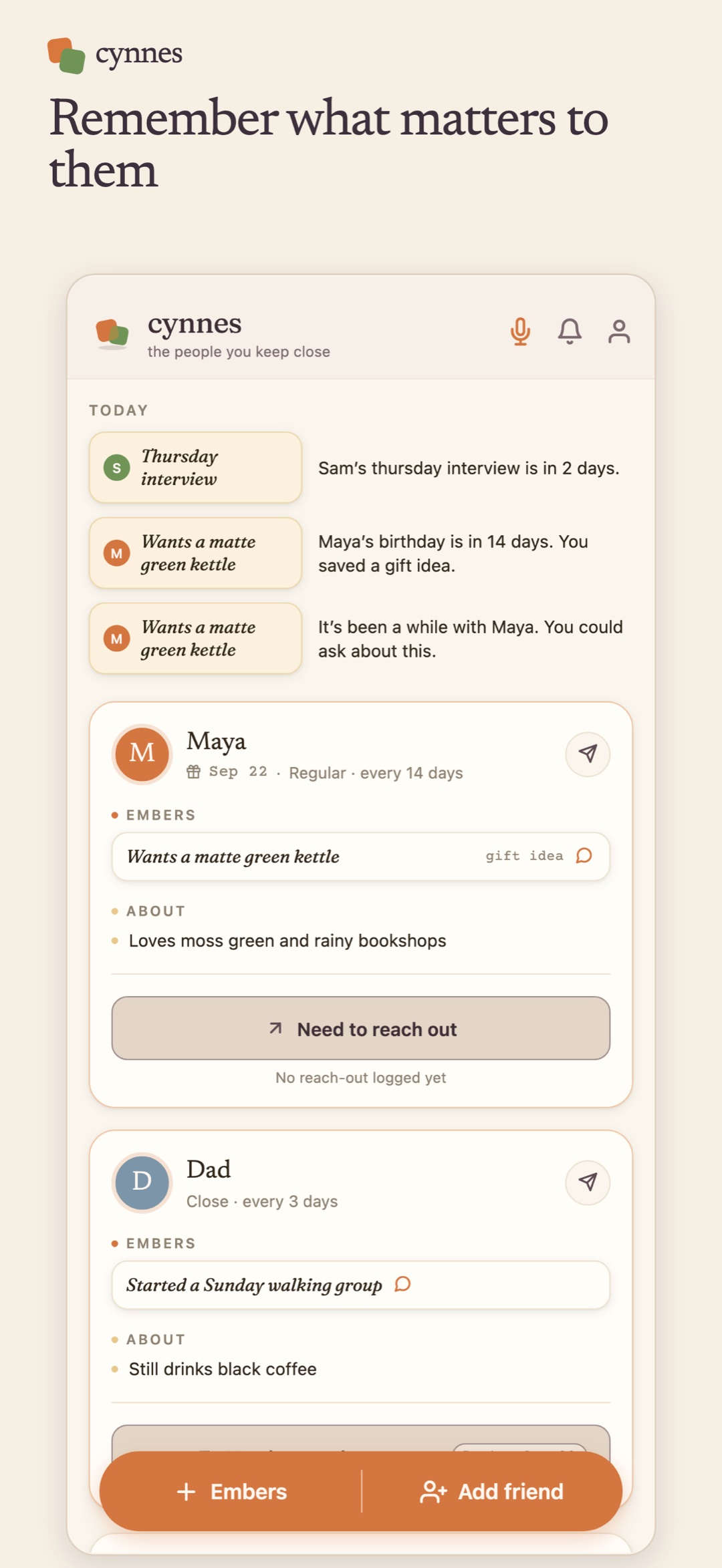
The problem
Small details are easy to lose between conversations: an interview date, a gift idea, a new interest, or something a friend is working through. A calendar can preserve a date, and a notes app can preserve a sentence, but the context is often scattered.
Cynnes is built around returning to that context. A saved detail becomes useful when it helps someone remember what to ask about, choose a gift, or reach out at a thoughtful moment.
From remembering to reaching out
Capture a note by text, voice or photo on a person's card. When describing someone new, review suggested details before saving them. The product distinguishes active, changing threads from more durable About facts.
Connect the detail to a birthday, life event or optional reach-out rhythm. A favorite can remain an ordinary note; every detail does not need a notification.
Return to the saved context before contacting the person. A check-in draft can be edited, copied or shared, but the user chooses what to send. Logging “I reached out” is a separate explicit action.
- People cards collect a person's notes, useful facts and upcoming moments.
- AI-assisted organization helps file captured details.
- Birthday and life-event reminders attach timing to context.
- Optional reach-out rhythms can be snoozed or turned off.
- Search makes previously saved details easier to retrieve.
One small example
Sam mentions that an interview is on Friday. Save that detail on Sam's card and add the event if a reminder would help. Before the next conversation, the detail gives a concrete place to begin: “How did the interview go?”
This is a fictional illustration of the intended flow, not a customer story or evidence that a message was sent.
Product choices
The app works for one person. It has no public feed, friend requests, follower counts or relationship scores. Notes are not shared with the people on the cards.
Capture is kept close to the main experience, while review preserves the distinction between a suggested detail and a saved fact. Reminders are optional prompts to act; the product does not send messages automatically.
The product's warm visual identity belongs to Cynnes. This portfolio page explains the work while preserving that identity inside authentic product imagery.
What private means here
Private means private to the user's account, not device-only storage. Supabase stores account data and saved content. Relevant text is sent to Anthropic for AI-assisted organization and story-to-card suggestions. Check-in drafts are generated locally.
The public privacy policy explains these boundaries. The portfolio does not claim end-to-end encryption or guarantee improvements in relationships.
The data side
The app is built with TypeScript and React Native, with Supabase providing authentication, a PostgreSQL database and file storage. It records product events, and the project includes SQL signup-cohort queries for onboarding and feature activation.
Those queries count how many people in a signup cohort reached each stage. They do not establish the order of steps within a first session, and there are no usage results to report yet.
Current state
Cynnes version 1.0 is public on the US App Store; the listing went live on September 18, 2026. The app is a free download, and ongoing use after guided setup requires a subscription. Apple's purchase screen shows the current price.
An existing web app is also available, with features and purchases that may differ from the native app. No public Android release is advertised. Pricing and access details are kept on the product website so this portfolio does not preserve an outdated offer.